Person
Frederick Douglass
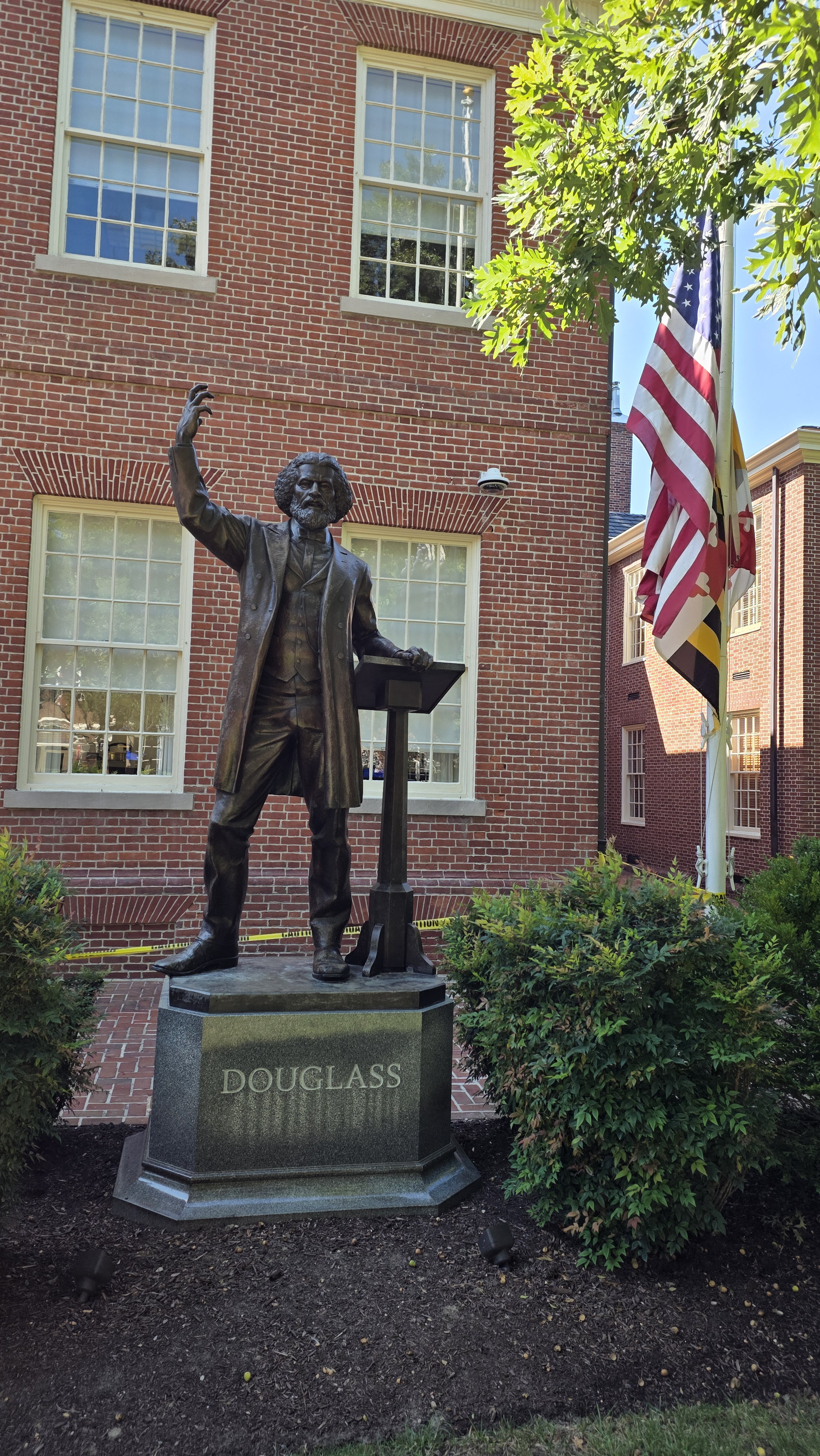
A statue of Frederick Douglass stands outside the Talbot County Courthouse in Easton, close to places that shaped his early life and his later return as one of the nation’s most important voices for freedom, equal rights, and human dignity.
The Frederick Douglass statue on the Talbot County Courthouse lawn in Easton is more than a memorial to a famous American. It stands in the county where Douglass was born enslaved, near places tied to both the violence of slavery and the public life he later claimed through his words, work, and courage.
Douglass was born Frederick Augustus Washington Bailey in Talbot County around 1818. As a young man, after an attempted escape from slavery in 1836, he was held in the Easton jail near the courthouse. He later reached freedom in 1838 and became one of the most powerful abolitionist writers and speakers of the 19th century, known for his autobiographies, anti-slavery advocacy, newspaper work, and public service.
His connection to Easton did not end with captivity. In 1878, Douglass returned to Talbot County as a nationally known orator and delivered his “Self-Made Men” speech inside the courthouse to a segregated audience. The return carried deep meaning: a man once jailed in Easton for trying to be free had come back as a respected public figure whose voice reached far beyond the Eastern Shore.
The bronze statue, created by sculptor Jay Hall Carpenter, was unveiled in 2011 after years of local effort led by the Frederick Douglass Honor Society and community partners. It depicts Douglass as an elder statesman at a lectern, hand raised as if addressing a crowd. On the courthouse grounds, the pose invites people passing through Easton to remember Douglass not only as a historic figure, but as a Talbot County native whose life continues to challenge the Shore to face its past honestly.
For visitors and locals alike, the statue is a quiet but important stop in Easton. It connects the town square to the larger story of slavery, resistance, citizenship, and the long struggle for equal rights. It also keeps Douglass’s Shore roots visible in the public landscape, where history is not something distant, but something people walk past, photograph, and reconsider in the present day.